Deck Board Calculator
Determine the exact quantity of decking boards, fasteners, and linear footage required for your deck project.
How to Use the Calculator
Use this deck board calculator to figure out exactly how many retail boards, surface fasteners, and linear feet you need for your deck’s surface layer based on physical layout rows.
- Enter your deck length (parallel to the joists) in feet, inches, and fractions (e.g., 14′ 0″).
- Input the deck width (perpendicular to the joists) using feet, inches, and fractions.
- Select your exact deck board width, including any fractions (e.g., 5 1/2″ for standard 5/4×6 boards).
- Choose the required expansion gap between boards (typically 1/8″ or 3/16″).
- Select your purchased board length based on standard retail sizes (8′ to 20′).
- Pick your underlying joist spacing (12″, 16″, or 24″ on center).
- Choose your fastener type—either face screws (2 per joist intersection) or hidden clips (1 per joist intersection).
- Add a waste factor percentage (10% is standard) to account for required cutoffs and end-squaring.
Understanding Your Results
- Effective Width & Courses: Adds your physical board width to the expansion gap, then divides the deck length by this number to simulate physical rows (“courses”), ensuring you do not come up short.
- Total Linear Footage: Multiplies the total number of required courses by the deck width to give you raw linear feet before board division.
- Exact Boards Needed: Takes your total linear footage, divides it by your selected purchased board length, applies your waste factor, and rounds up to the nearest whole retail board.
- Exact Fastener Count: Uses the “n+1 rule” for joists to ensure edge support, multiplying total joist intersections by your chosen fastener type multiplier, plus the waste factor.
This tool prevents the common amateur mistake of simply dividing total square footage by board area. By physically mapping out courses, expansion gaps, and whole retail lengths, you get a realistic material list that holds up at the hardware store.
Tools Needed
- Tape measure
- Miter saw or circular saw
- Impact driver or cordless drill
- Chalk line
- Spacers (e.g., 1/8″ or 3/16″ plastic deck spacers)
Materials Needed
- Decking boards (e.g., 5/4×6 pressure-treated pine, cedar, or composite boards in 12′ or 16′ lengths)
- Deck fasteners (e.g., 2 1/2″ exterior-grade polymer-coated deck screws, stainless steel screws, or specific hidden fastener clip assemblies)
- End-grain wood sealer (if cutting natural wood boards)
Always check local building codes and HOA guidelines before starting.
How many deck boards do I need?
To determine exactly how many deck boards you need, divide your total linear footage by the length of the retail boards you plan to buy (such as 12′ or 16′ lengths). Always factor in your exact board width, expansion gaps, and a 10% waste factor to guarantee full surface coverage.
Enter your exact deck framing dimensions above to instantly generate your exact retail board count and required hardware.
Project Overview
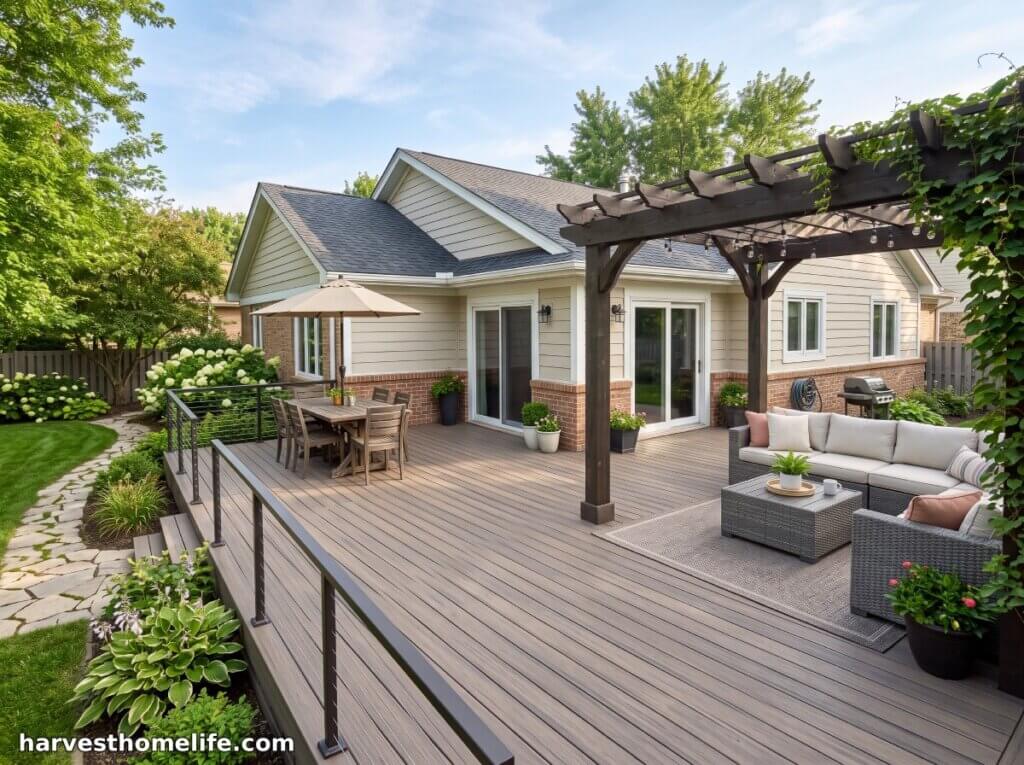
Planning your outdoor living space requires more than a rough guess; that is where a precise deck board calculator becomes your most practical asset. Relying on simple area division often leaves you a few boards short, stalling the project mid-build. By accurately combining the physical width of the material with the necessary structural expansion gaps, you get a reliable, highly accurate material list.
Whether you are laying standard pressure-treated pine or high-end composite material, this decking estimator handles the heavy lifting behind the scenes. This specific deck board spacing calculator mathematically runs physical courses across your joists, applies the necessary waste factors, and calculates fastener volumes so you can focus entirely on making straight cuts and driving screws. Note that this tool covers your surface material only, not the underlying posts, beams, or framing joists.
Hardware & Material Guide
Understanding the physical materials and strict spacing requirements guarantees your estimated numbers hold true during real-world installation.
How do you measure deck length and width correctly?
Length runs parallel to your joists, while width runs perpendicular. Since deck boards lay across the joists, establishing these dimensions correctly determines how many full courses you need. Measure framing outside-to-outside to the exact fraction of an inch to prevent compound errors over a 20-foot span.
Why must you factor in expansion gaps and actual board dimensions?
Wood and composite materials expand and contract with temperature and moisture shifts. Leaving a 1/8″ to 3/16″ gap between boards provides mandatory water drainage and prevents the surface from buckling. A standard 5/4×6 board is physically 5 1/2″ wide. Adding the gap gives you the “effective width,” which is the true space each board occupies on the frame.
How does the calculator use math to estimate decking materials?
A reliable deck square footage calculator must calculate physical space based on actual courses rather than theoretical geometry.
Linear Footage vs. Square Footage
Square footage tells you the total flat area, but linear footage measures the total length of the boards laid end-to-end. Because you purchase lumber by the linear foot in standard retail lengths (8′, 10′, 12′, 16′, 20′), linear footage is the only practical metric for buying building materials at the lumber yard.
Figuring Out Fastener Counts (Screws vs. Hidden Clips)
The “n+1″ rule dictates your framing joist count. A 16-foot wide deck framed 16” on center requires 13 joists, not 12, because you need support on both outside edges. Every point where a decking board crosses a joist creates an intersection. Face-screwing takes two screws per intersection, while hidden systems require exactly one clip.
What are the standard decking sizes and recommended joist spacings?
Most residential deck frames utilize joists spaced 16″ on center for standard perpendicular board installation. If you plan to lay boards on a 45-degree angle, you must tighten your joist spacing to 12″ on center to prevent the boards from sagging under weight.
| Nominal Board Size | Actual Physical Width | Typical Joist Spacing (Perpendicular) | Typical Joist Spacing (Diagonal) |
|---|---|---|---|
| 5/4 x 6 | 5 1/2″ | 16″ On Center | 12″ On Center |
| 2 x 6 | 5 1/2″ | 16″ or 24″ On Center | 16″ On Center |
| 2 x 4 | 3 1/2″ | 16″ On Center | 12″ On Center |
Frequently Asked Questions
Q. How many deck boards do I need for a 14×20 deck?
A. For a 14×20 deck, assuming the boards run parallel to the 20-foot width, you will need 30 courses of standard 5 1/2″ boards spaced with a 1/8″ gap. If buying 16-foot boards, you need exactly 42 boards once you apply a standard 10% waste factor for trimming and cutoffs.
Q. What size are standard deck boards?
A. A standard “5/4×6″ decking board is not actually 6 inches wide. Its true physical dimension is 1″ thick by 5 1/2” wide. You buy these boards in standard even-foot retail lengths ranging from 8′ up to 20′.
Q. How many screws do I need per deck board?
A. You need two face screws for every point where the deck board crosses a framing joist. If your joists are spaced 16″ on center, an 8-foot board will cross 7 joists, requiring 14 screws. If using hidden fastener clips, you only need one clip per intersection.
Planning your next project? Browse our master hub of Free DIY Home & Garden Calculators to get instant material lists, spacing math, and budget estimates.