Range Hood CFM Calculator
Determine your required ventilation power (CFM) and the minimum duct pipe size needed for your specific kitchen setup.
How to Use the Calculator
Calculate your required ventilation power (CFM) and determine the exact minimum round duct pipe size needed to safely vent your kitchen.
- Select your Mount Type (Wall-Mounted or Island / Ceiling).
- Select your Stove Type (Electric or Gas) from the dropdown.
- Enter the Total BTUs of your appliance (required only if you selected Gas).
- Input your exact Stove Width using inches and standard fractions (e.g., 29 7/8″).
- Enter your Total Duct Length in feet to account for baseline static pressure.
- Enter the Number of 90° Elbows in your duct run to calculate airflow resistance.
- Select whether your duct run includes an Exterior Wall or Roof Cap.
- Enter your kitchen’s Ceiling Height, Length, and Width in feet, inches, and standard fractions.
Understanding Your Results
- Stove Baseline: For wall-mounted electric stoves, the math demands 100 CFM per linear foot of stove width (150 CFM for island mounts). For gas models, it requires 1 CFM per 100 BTUs of total burner output, or the physical width requirement—whichever is greater.
- Room Volume Baseline: Your total room volume in cubic feet is divided by 4 to guarantee the system completes 15 full air exchanges per hour.
- Friction Loss Buffer: Calculates static pressure resistance by adding 1 CFM per linear foot of ducting, 25 CFM for every 90-degree elbow, and 40 CFM for an exterior termination cap.
- Minimum Duct Size: Evaluates your final required CFM to assign standard rigid round duct sizing, scaling from a 6″ pipe up to a 14″ pipe for massive exhaust loads.
- Required Exhaust Power: The calculator compares both baselines, selects the higher number, and adds your friction loss buffer to guarantee your hood meets the exact physical demands of your layout.
You must purchase a range hood that meets or exceeds the Required Exhaust Power and pair it with the corresponding minimum duct pipe to ensure safe, adequate air cycling.
Tools Needed
- 25-foot tape measure (to measure stove width and room dimensions exactly)
- Stove manufacturer manual or specification plate (to locate total BTUs)
Materials Needed
- Rigid galvanized steel round duct pipe (sized exactly to the calculator’s minimum duct requirement)
- Aluminum foil HVAC tape (UL-listed, do not use standard cloth “duct tape”)
- Exterior roof or wall termination vent cap (with a built-in backdraft damper)
- Sheet metal screws (1/2-inch to secure duct joints)
- Exterior-grade silicone caulk (for weatherproofing the roof/wall penetration)
Always check local building codes and HOA guidelines before starting.
Range Hood Sizing & Planning Guide
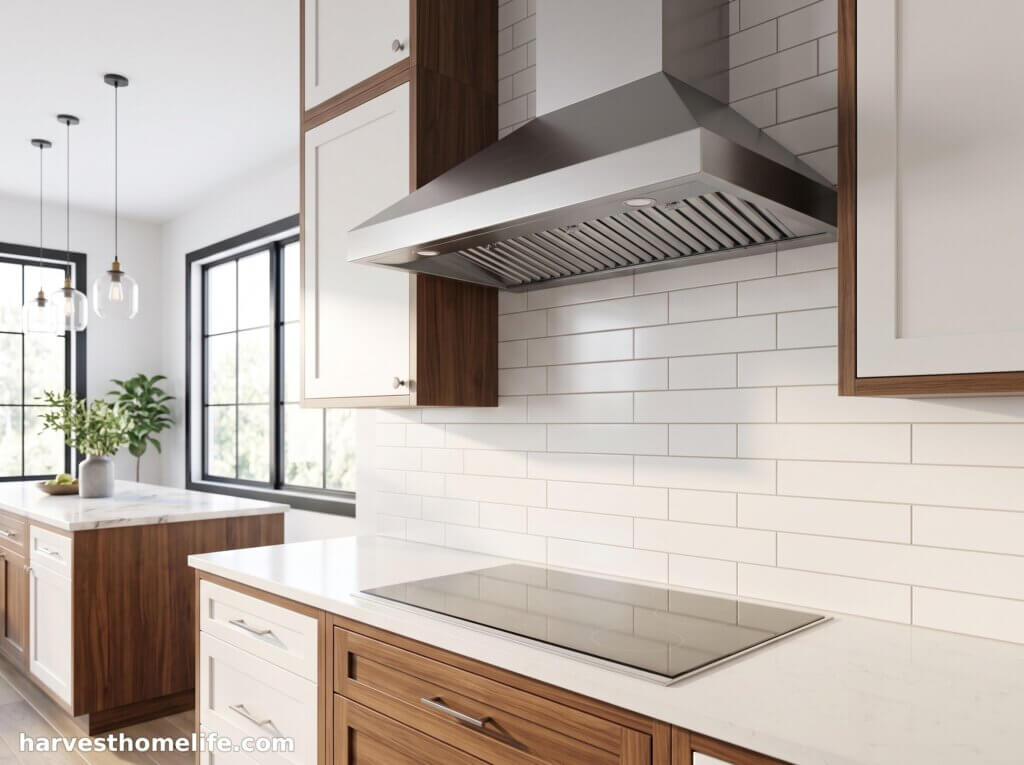
Why Sizing Your Range Hood Matters
Installing an underpowered range hood leaves grease and harmful cooking exhaust lingering in your kitchen, damaging cabinets and lowering indoor air quality. Conversely, installing an overpowered hood without proper planning can create a dangerous negative pressure environment inside your home.
The Science Behind CFM Math
A properly sized range hood and duct safely clear grease, smoke, and odors from your kitchen. Sizing your kitchen ventilation requires cold hard math, not guesswork. Using our range hood CFM calculator guarantees you have the exact exhaust power to pull smoke, grease, and heat out of your house. Applying the proper CFM formula ensures your fan matches the actual heat output of your burners, whether you run a standard electric range or a high-output gas appliance. The right cooktop CFM rating keeps your cabinets clean and your indoor air safe to breathe.
This tool specifically calculates your baseline appliance ventilation requirements, factors in the static pressure of your duct run, and assigns the correct range hood size and minimum round duct diameter. It determines the minimum exhaust power based on burner output, total room volume, and friction loss. You still need to account for dedicated makeup air requirements on high-CFM systems.
How to Measure Stove Width and Room Volume
Measure the physical width of your cooktop from edge to edge, not the cabinet cutout. For room volume, measure the total length, width, and ceiling height of the kitchen. If your kitchen is part of an open floor plan, measure the entire contiguous space, as the exhaust fan must overcome the un-walled air volume to create a proper draft.
How to Calculate CFM Requirements
Your required CFM is dictated by your stove type, mount location, and room size. For an electric wall-mounted stove, multiply the width of the stove (in feet) by 100. For an island mount, multiply by 150 to account for cross-drafts. For a gas stove, divide the total combined BTU output of all burners by 100. Finally, ensure the CFM is high enough to replace the entire volume of your kitchen’s air every four minutes.
Why Duct Size is Non-Negotiable
You cannot force 1,000 CFM of air through a standard 6-inch duct. Attempting to restrict a high-powered fan with a narrow pipe creates severe friction loss, causing the motor to burn out prematurely, increasing noise, and creating a major fire hazard. Always upgrade your ductwork to match the minimum diameter required by your hood’s CFM output.
How to Plan for Makeup Air and Building Codes
If your calculator results require a hood pulling over 400 CFM, most modern building codes legally require you to install a dedicated makeup air system. This automatically pulls fresh air into the house to replace the exhaust, preventing dangerous backdrafting of carbon monoxide from your furnace or water heater. Always verify thresholds with your local building inspector.
Frequently Asked Questions
Q. Is 300 CFM enough for a gas stove?
A. A 300 CFM hood only covers a gas stove outputting a maximum of 30,000 BTUs. Most standard gas ranges far exceed this output. To find your true baseline requirement, you must calculate your total combined burner BTUs and divide by 100. Furthermore, you must check your kitchen’s total cubic volume—your final CFM requirement will always be whichever number is higher to ensure safe air cycling.
Q. Is a higher CFM always better for exhaust fans?
A. Pushing extreme CFM ratings without proper planning causes dangerous pressure imbalances. Exhausting massive volumes of air creates negative pressure inside the house. Any hood pulling over 400 CFM typically requires a dedicated makeup air system to replace the air pushed outside.
Q. How do you determine the CFM requirements for a commercial kitchen?
A. Commercial systems require complex engineering well beyond standard residential math. You must account for heavy grease loads, extreme BTUs, continuous operation demands, and massive makeup air integration. Always hire a licensed mechanical engineer to appropriately size your commercial kitchen exhaust systems.
Planning your next project? Browse our master hub of Free DIY Home & Garden Calculators to get instant material lists, spacing math, and budget estimates.